
Maximum Weight Savings.
Proven Steel Performance.
Open grid decking is an all-steel bridge flooring system engineered to provide exceptional strength while minimizing the dead load placed on the structure.
What Is Open Grid Decking?
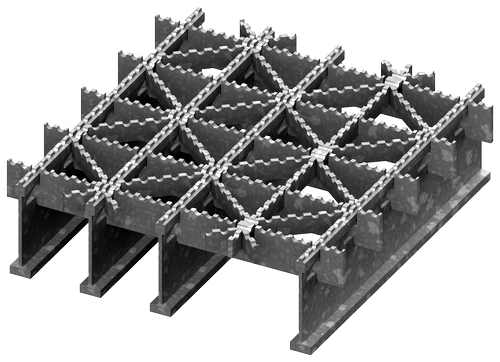
Open grid decking consists of interconnected steel members fabricated into rigid bridge deck panels. Main bearing bars carry primary traffic loads, while cross bars, supplemental bars and optional diagonal members distribute wheel loads throughout the deck.
Because the grid contains no concrete, the steel grid itself serves as the riding surface. Open grid systems can be produced in rectangular welded, diagonal welded and diagonal riveted configurations.
- 01Main bearing bars
- 02Cross bars
- 03Supplemental bars
- 04Diagonal bars (when applicable)
- 05Open drainage areas
Five Open Grid Models
Tap a model to see its section properties, spans and weight. Switch to the table to compare them side by side.
Representative values from the MCS Fabricated Bridge Products booklet. Open grid section modulus based on 50% of diagonal bars active. Actual weight and capacity vary with project specifications and must be confirmed by project engineering.
Representative Industry Specifications
- MCS system configurations
- 5″ 4-Way and RB open grid systems
- Typical deck weight
- ≈ 16–26 lb/ft² (common highway configs)
- Broader industry weight range
- ≈ 17–55 lb/ft²
- Common grid depth
- ≈ 5⅛ in
- Common steel strength
- ≈ 50 ksi structural or weathering steel
- Representative clear span
- ≈ 4.5–8.5 ft
- Available patterns
- Rectangular welded • Diagonal welded • Diagonal riveted
- Attachment methods
- Welded or bolted per project requirements
Specifications vary based on bar depth, spacing, steel grade, span, traffic loading, coating, connection type and project requirements. Final specifications must be confirmed through project-specific engineering.
PDF · Representative industry ranges · Not project-specific engineering.
Why Use Open Grid?
Lowest Possible Dead Load
Eliminating concrete significantly reduces the weight placed on girders, trusses, foundations and movable-bridge machinery.
Fast Installation
Shop-fabricated panels can be installed without waiting for concrete placement or curing.
Natural Drainage
Water, snow and debris can pass directly through the deck openings.
High Strength-to-Weight Ratio
The steel grid efficiently distributes traffic loads while keeping the deck system lightweight.
Multiple Grid Configurations
Rectangular, diagonal welded and diagonal riveted systems can be selected based on the structure and performance requirements.
Ideal for Rehabilitation
Open grid is especially useful when replacing an existing deck without adding unnecessary weight to the bridge.

Where Open Grid Performs Best
- Bascule bridges
- Swing bridges
- Vertical-lift bridges
- Steel truss bridges
- Weight-sensitive rehabilitation
- In-kind open-grid replacement
- Rapid replacement of short-span bridges
- Ferry ramps
- Ship lifts
- Temporary bridge structures
- Port and marine facilities
- Industrial floors
- Utility trench covers
- Heavy rolling-load applications
Open grid is often the preferred solution when reducing structural weight is more important than providing a traditional solid concrete roadway surface.
Know the Trade-Offs Up Front.
Open grid allows water, road spray and debris to pass through the deck and does not provide a solid protective surface over the structural members below. It can also produce more roadway noise and a different tire response than a concrete riding surface.
Grid pattern, roadway geometry, vehicle speed, skid resistance, coatings, drainage and maintenance access should be evaluated during the design process.
Is Open Grid Right for Your Project?
Is minimizing bridge deck weight the project's highest priority?
Does the structure require immediate drainage?
Is the bridge movable, weight-restricted or being rehabilitated?
If the answer to these questions is yes, open grid decking may be the right solution for your structure.
Build a Lighter, Stronger Bridge Deck.
MCS works with bridge owners, engineers and contractors to fabricate grid decking around each project's structural, dimensional and installation requirements.