
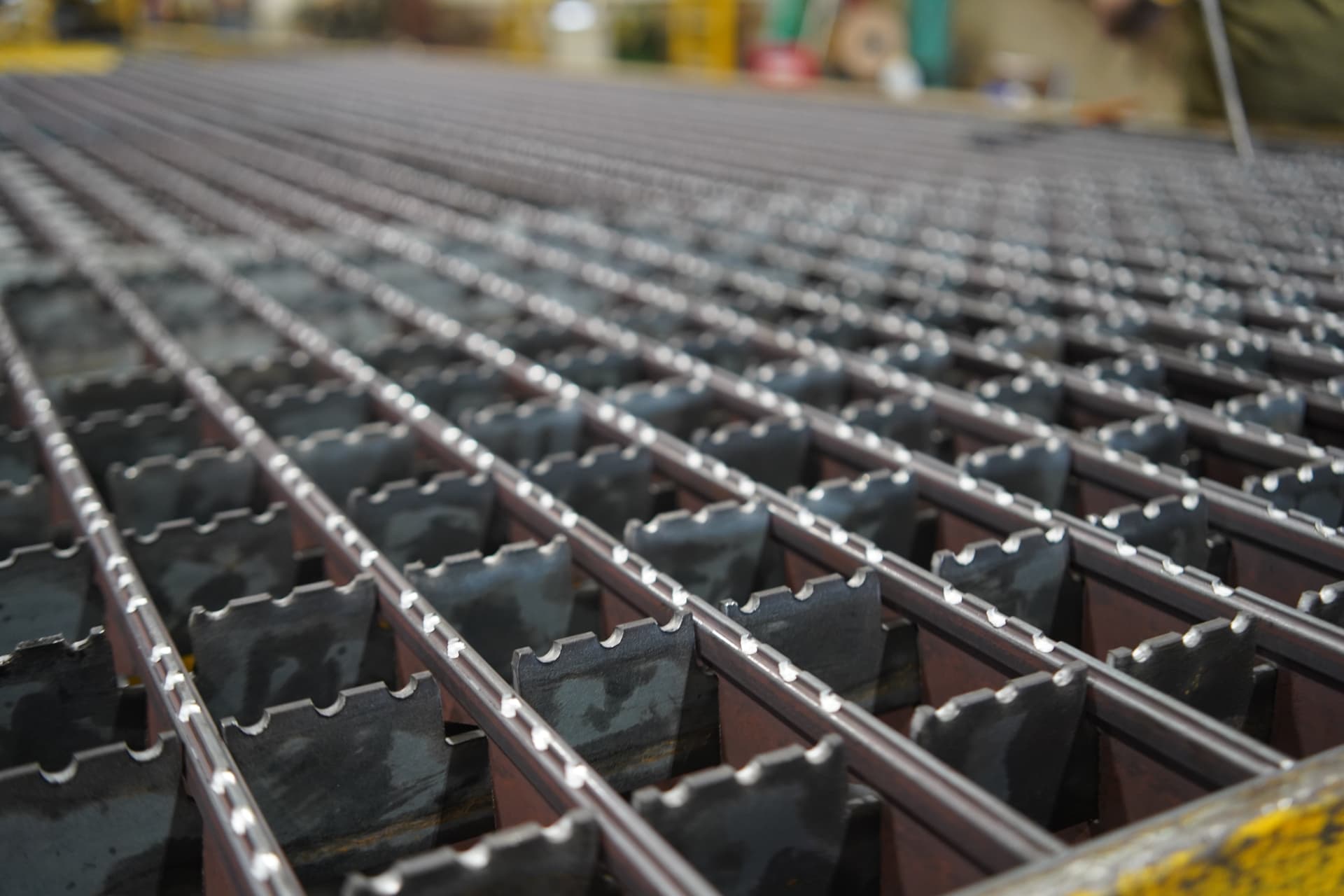
A side-by-side look at open, half-filled, fully filled, and exodermic-style grid deck systems.
Bridge grid deck systems balance dead load, riding surface, drainage, and lifecycle performance. This article compares the primary configurations and typical project priorities that shape system selection.
The same skeleton, four different decks
Open, half-filled, fully filled, and exodermic-style decks are all built from the same basic components: main bearing bars spanning between supports, cross bars welded across them, and depending on the system, supplemental and diagonal bars. What separates them is concrete, how much, where it sits, and whether it acts structurally with the steel.
That single variable drives almost everything an engineer cares about: dead load, riding surface, drainage, noise, deck stiffness, and long-term maintenance.
Open grid
With no fill, open grid is the lightest deck of the four by a wide margin. Water, snowmelt, and debris pass straight through, so there is no ponding and no need to build cross slope into the deck for drainage alone.
It is the traditional deck for movable bridges, bascule, lift, and swing spans, where deck weight directly affects balance, counterweights, and machinery loads. It also appears on ferry ramps, ship lifts, and industrial platforms and trench covers.
The trade-offs are a steel riding surface rather than concrete, more tire noise, and a surface where skid treatment is part of the specification rather than an afterthought.
Half-filled grid
Half-filled grid places concrete to roughly mid-depth of the grid, leaving the upper portion of the steel exposed. The result is a solid, sealed running surface over part of the section while keeping weight well below a full-depth slab.
It is a frequent choice on fixed highway and municipal rehabilitations where the owner wants a concrete riding surface but the existing superstructure cannot absorb the dead load of a conventional deck.
Fully filled grid
Fully filled grid is concreted through the full depth of the grid, typically with a wearing surface above. It behaves and rides much like a conventional deck, seals the steel, and gives the smoothest and quietest surface of the filled options.
It is the heaviest of the grid systems and the lightest-weight benefit is smaller, but it is still meaningfully lighter than a cast-in-place slab of comparable capacity, which is often enough to make a rehabilitation work.
Exodermic-style grid
In an exodermic-style deck, an unfilled steel grid is made composite with a reinforced concrete slab placed above it. The concrete takes compression, the steel grid takes tension, and the two work together as one section.
This produces a stiff, strong deck at a lower weight than a full-depth reinforced concrete slab, which suits longer stringer spacings and high-volume highway structures. It is the most involved of the four to detail and place, and it asks the most of the composite connection details.
Side-by-side priorities
- Lowest dead load: open grid, then half-filled, then exodermic-style, then fully filled
- Best riding surface and lowest noise: fully filled and exodermic-style
- Free drainage through the deck: open grid only
- Movable bridges: open grid in nearly all cases
- Rehabilitation with a tight load-rating margin: open or half-filled
- High-volume highway deck replacement: fully filled or exodermic-style
How to narrow it down
Start with the load rating and the movable-versus-fixed question, because those two eliminate options fastest. Then weigh riding surface and drainage expectations against the remaining candidates, and check the result against your closure window and staging plan.
Panel depths, bar spacings, and span capabilities vary by system and by project, so treat published values as a starting point and confirm the configuration against your specific structure. Send the drawings and the bridge team will tell you which systems your structure can actually accept.
Need project-specific guidance on this topic? The MCS bridge team can walk through details, drawings, and options for your structure, call (814) 497-5001.