
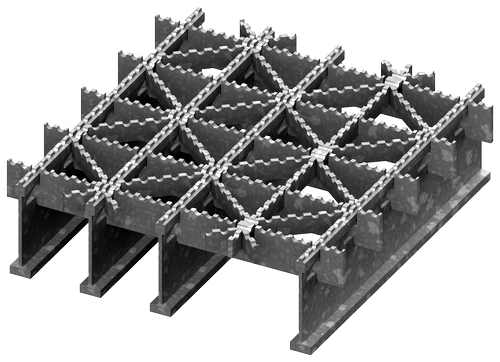
Technical Collaboration From System Selection Through Final Fabrication.
MCS works with bridge design teams to evaluate grid type, panel configuration, fabrication requirements and construction considerations around the needs of each structure.
Start With the Structure, Not the Product
Selecting a bridge deck requires more than comparing material weights. The design team must evaluate span, dead load, fatigue, stiffness, riding surface, drainage, geometry, support spacing, connection details, construction sequencing and long-term maintenance. MCS supports a system-selection process that begins with the bridge's actual requirements.
What's on Your Plate
- 01Dead-load limitations
- 02Clear span
- 03Traffic loading
- 04Fatigue performance
- 05Deck depth
- 06Floor-beam spacing
- 07Deflection criteria
- 08Riding-surface requirements
- 09Drainage
- 10Corrosion protection
- 11Composite action
- 12Installation method
- 13Maintenance access
- 14Owner standards
Why Engineers Consider Grid Decking
Dead-Load Reduction
Grid systems can substantially reduce the weight placed on an existing or new structure.
Multiple Configurations
Open, Exodermic, half-filled and fully filled systems offer different combinations of weight, stiffness, span and ride quality.
Longer Span Potential
Exodermic systems can provide greater span capability and may allow simplification of the supporting floor system.
Rehabilitation Compatibility
Grid decking is useful where existing trusses, girders, bearings or foundations have limited reserve capacity.
Accelerated Construction
Prefabricated and precast panels can support staged construction and limited closure periods.
Custom Geometry
Panels can be fabricated around skew, crown, cross slope, superelevation, drainage features and irregular framing.
Composite Design Options
Filled-grid systems can be designed to interact with supporting members through shear studs and concrete haunches.
System-Level Coordination
MCS can help identify fabrication, panelization, delivery and installation issues during design rather than after award.
Comparing deck systems? Share the bridge geometry and performance requirements.
Plan Your ProjectSelecting the Appropriate Grid System
Open Grid
Consider when minimum dead load, movable structures or immediate drainage are the priorities.
- Minimum dead load is the priority
- Structure is movable or weight-sensitive
- Immediate drainage is desirable
- A solid riding surface is not required
- Existing open grid is being replaced in kind
Exodermic®
Consider when longer spans and a solid concrete riding surface are required.
- Longer deck spans are required
- A solid concrete riding surface is needed
- Dead-load reduction remains important
- Precast construction is being evaluated
- The supporting floor system may be simplified
Half-Filled Grid
Consider when the project needs a balance between weight and ride quality.
- Balance between weight and ride quality
- Solid concrete surface required
- Moderate span capability
- Precast or cast-in-place construction
- Moderate dead-load restrictions
Fully Filled Grid
Consider when a robust solid deck with high stiffness is the priority.
- Robust solid deck is the priority
- High stiffness and load distribution
- Supporting structure accommodates greater weight
- Heavy-use or industrial conditions
- Prefabricated panels could reduce field forming
Support at Different Design Stages
- STEP 01
Concept Development
Compare grid systems · Determine whether grid decking should remain under consideration
- STEP 02
Preliminary Design
Review representative weight, depth, span · Discuss configuration and constructability information
- STEP 03
Final Design
Coordinate panelization and interfaces · Connections, materials, coatings and specifications
- STEP 04
Construction Support
Respond to fabrication and field questions · Coordinate with contractor and owner
Specification & Procurement Clarity
A grid-deck specification should clearly define performance requirements without unintentionally restricting competition or overlooking constructability. Encourage designers to clearly identify performance loading, materials, coatings, concrete, riding surface, fatigue and deflection criteria, connection requirements, shop-drawing responsibilities, and quality documentation.
- Applicable design criteria
- Required system type
- Performance loading
- Coating or galvanizing
- Fatigue & deflection limits
- Connection requirements
- Shop-drawing responsibilities
- Testing & inspection requirements
Technical Information Available for Design Teams
Published values should be used for preliminary evaluation only. Final dimensions and capacities must be established through project-specific engineering and the applicable owner requirements.
Plan Your Project- Representative weight ranges
- Typical grid depths
- Common bearing-bar spacing
- Preliminary span information
- Panel-layout considerations
- Grid cross-sections
- Connection concepts
- Concrete placement configurations
- Precast and cast-in-place considerations
- Material and coating options
- Fabrication limitations
- Shipping and erection considerations
Common Questions
MCS can provide representative system information and fabrication considerations to support the engineer's evaluation.
No. Grid decking is used on movable bridges, fixed bridges, truss rehabilitation, accelerated replacement and industrial applications.
Grid panels can be fabricated for project-specific skew, slopes, crowns, panel breaks and framing conditions.
Exodermic, half-filled and fully filled systems can be incorporated into precast panel construction when appropriate.
Final structural design and approval remain subject to the engineer of record, owner requirements and applicable design standards.
Evaluate the Deck System Before the Details Are Locked In.
Share your bridge geometry, support spacing, loading requirements and project goals with MCS. We will help your team identify relevant grid-system and fabrication considerations.